
When the Grove Rang with Praise
The remarkable story of the Dover-Foxcroft camp meetings, where thousands once gathered beneath the maples and hemlocks for preaching, prayer, sacred song, and Christian fellowship.
A grove, a spring, and a gathering place
The first Methodist camp meeting on Summer Street in Foxcroft was held during the first week of September 1880.
Efforts to move the annual gathering here from Charleston, where it had been held for 14 years, failed in 1873 because a committee could not raise enough money to purchase the land. That problem was solved in 1879 when local citizens of all denominations subscribed liberally toward the purchase of the grounds.
The chosen site was ideal: a grove of maples and hemlocks provided shade for the hundreds who would tent there, and a magnificent spring supplied an abundance of water. Foxcroft also had something the previous location did not – a railroad capable of bringing hundreds of worshippers into town on special excursion trains.
In December 1879, the Piscataquis Valley Camp Meeting Association was incorporated. By mid-August of the following year, the grounds were ready. A fountain was built to provide water of “great volume, coldness and purity.” Families built cottages, while others lived in tents throughout the seven-day meeting.
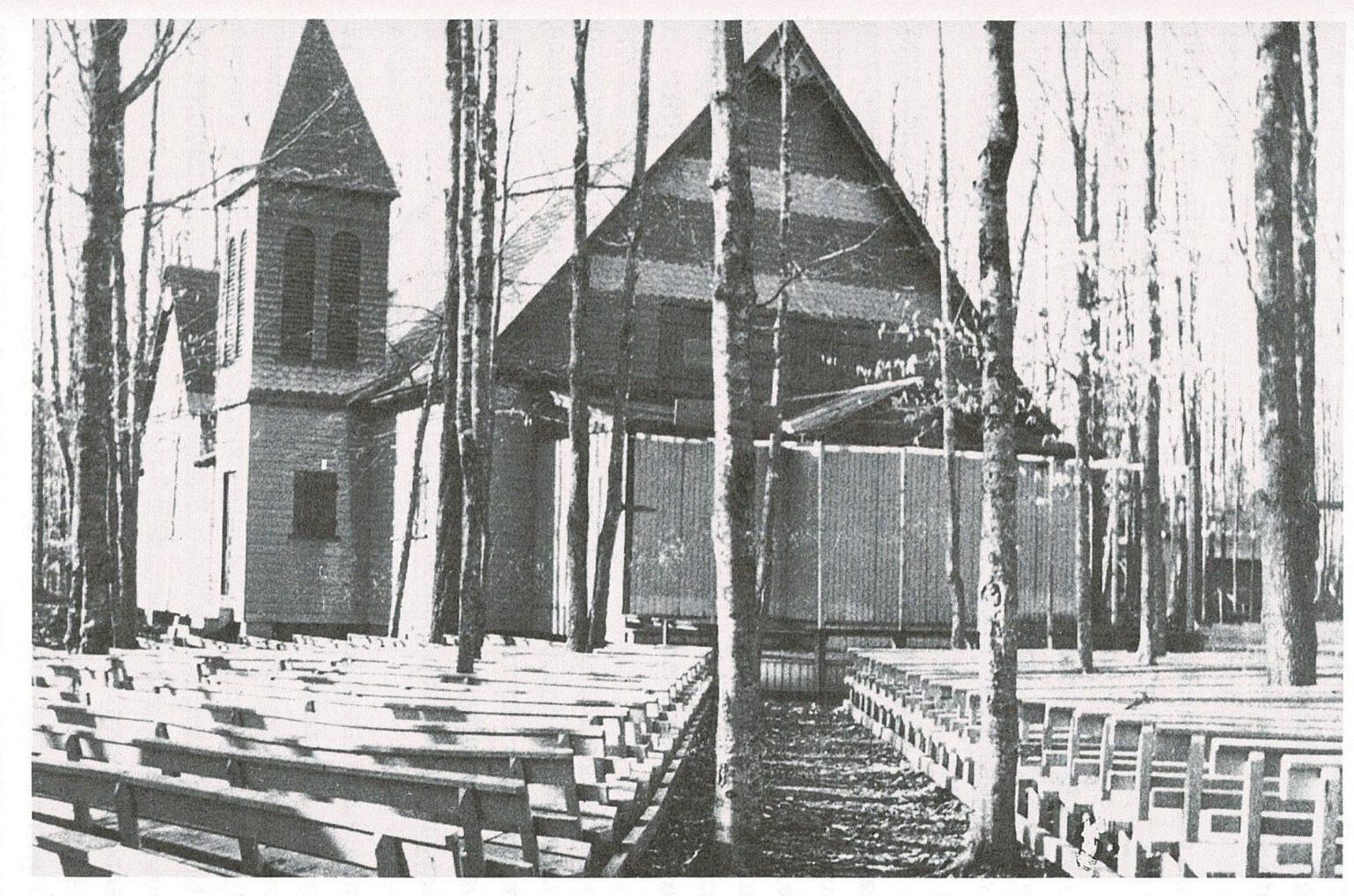
At its height, the campground held approximately 130 cottages and tents, thousands of outdoor seats, and a chapel large enough for nearly 1,200 people.
The meeting takes root
The meetings quickly became popular, especially with visitors arriving by train. More than 3,000 attended on Sunday in 1885. The local newspaper observed that hotels, restaurants, and livery stables reaped a “good harvest during the week.” The success was both spiritual and financial, allowing the association to finish paying for the grove, construct a stable for 20 horses, and add more cottages.
The first of several Sunday crowds numbering 5,000 arrived on August 29, 1886. The following year, improvements were made to the walks. On one particularly dusty day, an enterprising carriage owner charged each person five cents for a ride from the railroad station to the grove. A liquor peddler also appeared, hoping to dispense “the ardent to the thirsty,” but was arrested and fined $25.
More cottages went up in 1887 and 1888. Streets and lighting were improved, and the grounds were carefully maintained. A list printed in the newspaper named 275 families staying in the tents and cottages, where “most excellent order” was maintained.
The grounds never looked more beautiful.Local newspaper account
After one meeting, the association reported 80 conversions during the week and $1,200 in the treasury. It voted to build a new chapel seating nearly 1,200 people. A crew of 25 men and 15 horses from eight area towns removed 21 trees and stumps to prepare the site.
The chapel was erected in 1890 and given a new coat of paint in 1891, when 20 clergymen conducted week-long services attended by nearly 4,000 on the final Sunday. The next year, lift windows were installed to improve ventilation.
In the summer of 1893, the Epworth League of Dexter built Epworth Hall for $700. The two-story building measured 24 by 45 feet, with an 18-foot cooking extension and a large meeting room on the first floor.
The great decade
In December 1893, the courts ruled that Foxcroft could tax the association’s land and cottages because the grounds were used for more than religious purposes. Facing a $900 debt and years of receipts that had failed to meet expenses, the association began charging admission in 1894: 20 cents for a season ticket, 10 cents for a day ticket, and five cents for a single service.
The years from 1894 through 1903 became the greatest decade in the 47-year history of the camp meeting. Thousands arrived on special excursion trains from Greenville, Bangor, Newport, and Houlton. Hundreds lived in cottages and tents during the week. New streets, fences, walks, stables, and cottages were added, and by 1901, “one of the most beautiful and best equipped camps in the state” was entirely out of debt.
By midweek in 1894, 1,000 people had settled into the cottages and tents, ready for three daily services at 10, 2, and 7. On Sunday, no fewer than 4,000 people filled the grounds, yet quiet and good order prevailed.
In 1896, approximately 4,000 seats with backs were installed and painted. Around 6,000 attended that Sunday, including 700 who arrived by train. Horses and wagons crowded the grounds, an awning shaded the speaker’s stand, and the superintendent lit 74 lamps each night.
The railroads offered half-fare rates throughout the week in 1897. On Sunday, all 4,000 seats were taken and nearly 1,000 people stood for the two services. The woods were filled with horses, and many families ate dinner from shoeboxes while perched on their wagons.
Ideal weather drew another 6,000 in 1898. The large crowds supplied funds for a 2,140-foot wooden fence made with 4,200 pickets, new walks, a freshly painted chapel, and additional lights. By mid-August, the 130 cottages and tents were filled.
Three Bangor & Aroostook excursion trains brought approximately 1,000 of the 5,000 attendees in 1900. In 1902, three acres of trees were cleared to make additional room for horses and wagons. Twenty-five Methodist ministers preached throughout the week, and the largest Sunday crowd in the meeting’s history – more than 6,000 – arrived by teams from rural areas and heavily loaded trains from every direction.
The grove was filled with an outpouring of people…yet quiet and the best of order prevailed.The Observer, 1894
It is easy to understand why so many came: few settings could have been more attractive for a church service than the shade of the great trees. Friends reunited, excursionists enjoyed a train ride, excellent preaching filled the day, and the music of thousands of voices carried through the grove.
Changing times and a final meeting
The association made a costly decision when it ended the meetings on Saturday night in 1904 and 1905. The great Sunday crowds disappeared and never fully returned when Sunday services resumed in 1906, although crowds of around 3,000 remained common until the outbreak of World War I.
One exception came in 1909. A 13-coach train from Houlton carried 1,110 excursionists, while trains from Bangor and Greenville each brought roughly 600 passengers. Many others arrived by horse teams and automobiles – the first time cars were mentioned in accounts of the gathering. The crowd was estimated at more than 5,000, and restaurants and grocery stores were “taxed to the utmost” supplying food.
At the 34th annual meeting in 1913, many members of the Woman’s Christian Temperance Union gathered to honor Lillian Stevens of Dover, who had served as both state and national president of the Union. In 1914, the association spent $700 on a new platform for the tabernacle, added lights, and removed rocks and roots. Sunday crowds, however, had fallen nearer to 2,000.
The meetings continued through World War I, including record attendance for the week in 1916. By 1921, the association faced a serious problem when the State Board of Health condemned the grounds. Although the cottages were originally intended only for use during camp meeting, 15 to 20 families were living there year-round amid dampness, inadequate drainage, and no proper toilet facilities.
In September 1925, trustees and members of the Piscataquis Camp Meeting Association voted to close the grounds to occupancy after May 1, 1926. The final camp meeting was held that year.
From tabernacle to Crystal Ball Room
Unsanitary conditions, declining attendance, pressure from state health officials, the loss of excursion trains, changing religious life, and the growing popularity of automobiles all played a part in the association’s decision to sell. On October 10, 1927, it met to consider the sale of its real estate, cottages, and tabernacle.
Fred Farris purchased the property and planned to convert the cottages into overnight camps, anticipating greater traffic along Summer Street after the new road to Milo was routed over the hills. Epworth Hall was moved nearer the street and became a home for Forrest and Gladys Farris; for many years, they also operated a store there.
For a few summers, the grove that had once echoed with thousands of voices singing “Rock of Ages” and “Nearer, My God, to Thee” fell silent. Inside the tabernacle, however, construction began. The church was transformed into a dance pavilion with a hardwood floor, an orchestra stage, and a remodeled interior.
Its most memorable feature was a gigantic crystal ball covered with small mirrors and turned by a motor. Colored lights in each corner struck the thousands of reflectors, filling the room with gently moving dots of color.
Come and dance under the crystal ball.Newspaper invitation, May 1929
The grand opening of the “Crystal Ball Room” took place Friday night, May 17, 1929. Admission was 75 cents for gentlemen and 35 cents for ladies. A large crowd attended and was delighted by the novelty of the ball. The pavilion remained popular for many years, but the arrival of television contributed to the decline of dance halls, and the last dances were held around 1953.
A name the town remembers
Many cottages were eventually winterized for year-round living, and a soft drink company drew its water from the great spring. Over time, the cottages succumbed to age, the fence and pews were removed, the bottling company ceased operations, and the church-turned-pavilion became weather-beaten and dilapidated.
As the people who remembered the great church gatherings, the dance hall, or the old neighborhood grew fewer, the nickname “campground” was heard less often. Yet the name – and the memory behind it – never disappeared entirely.
The echoes remain
On a warm September afternoon in the quiet grove, one can almost imagine 5,000 worshippers lifting their voices in a closing hymn beneath the elms and hemlocks – a reminder of the generations who once gathered here to seek the Lord together.